Outdoor Decor
Small-Space Outdoor Decor: 8 Ways to Make a Tiny Patio Feel Like a Garden Room
A tiny patio is not a shrunken garden. It is a room with the sky for a ceiling, which is why most generic garden advice lands badly — it assumes ground you can spread out on. A three-metre terrace rewards a different approach: fewer things, better sized, placed with the same care you would give a small kitchen. The ideas below cover the parts that change the most in a compact space — furniture scale, vertical planting, zoning, light, and a little softness underfoot — in roughly the order worth tackling them. None of them need a builder, and most can be undone if you rent.
Right-Size the Furniture Before Anything Else
Most disappointing small patios are not badly planted. They are badly furnished, usually because someone bought a set designed for a terrace twice the size. Before you look at a single chair, measure the clear paved area and sketch it. Then mark your shortlist on the ground with masking tape and walk around it for a day. It sounds fussy; it saves you from the table you have to squeeze past sideways every time you carry out a cup of tea.
Start with the walking line
The route from the door to the far end matters more than any single piece of furniture. Protect it first, then fit everything else around it.
- Leave at least 60 cm of clear paving between a chair back and a wall or planter; allow 75 cm where people need to pass comfortably.
- Choose a round or oval table around 60–70 cm across for two, and about 80 cm for four. Corners are what make small tables feel tight.
- Measure chair depth, not just width. A deep armchair can add 70 cm to a table's real footprint.
- Keep a table surface roughly 28–30 cm above the seat for comfortable eating.
- Push the heavy, permanent pieces against one wall or into one corner, so one obvious route stays open.
Low-backed chairs keep sight lines clear, which matters if you have a view or a boundary worth looking at. If the space is very tight, a bench along the wall plus two folding chairs beats four chairs you cannot move.
Buy pieces that do two jobs
A wall-mounted drop-leaf table that folds flat, a bench with a lift-up lid for cushions, nesting side tables, a folding bistro set that hangs on two hooks when not in use — these are not compromises. They are what makes a small room work. Aim for one storage piece, one flexible table, and seating that can be cleared away in under a minute.
Push the Garden Up the Walls
Floor space is your scarcest resource, and walls are almost always empty. Use them and the patio gains plants without losing a centimetre of standing room. The trick is to treat the wall as a border bed rather than a display shelf: a few larger, well-planted pieces read better than twenty small pots.
What grows well vertically
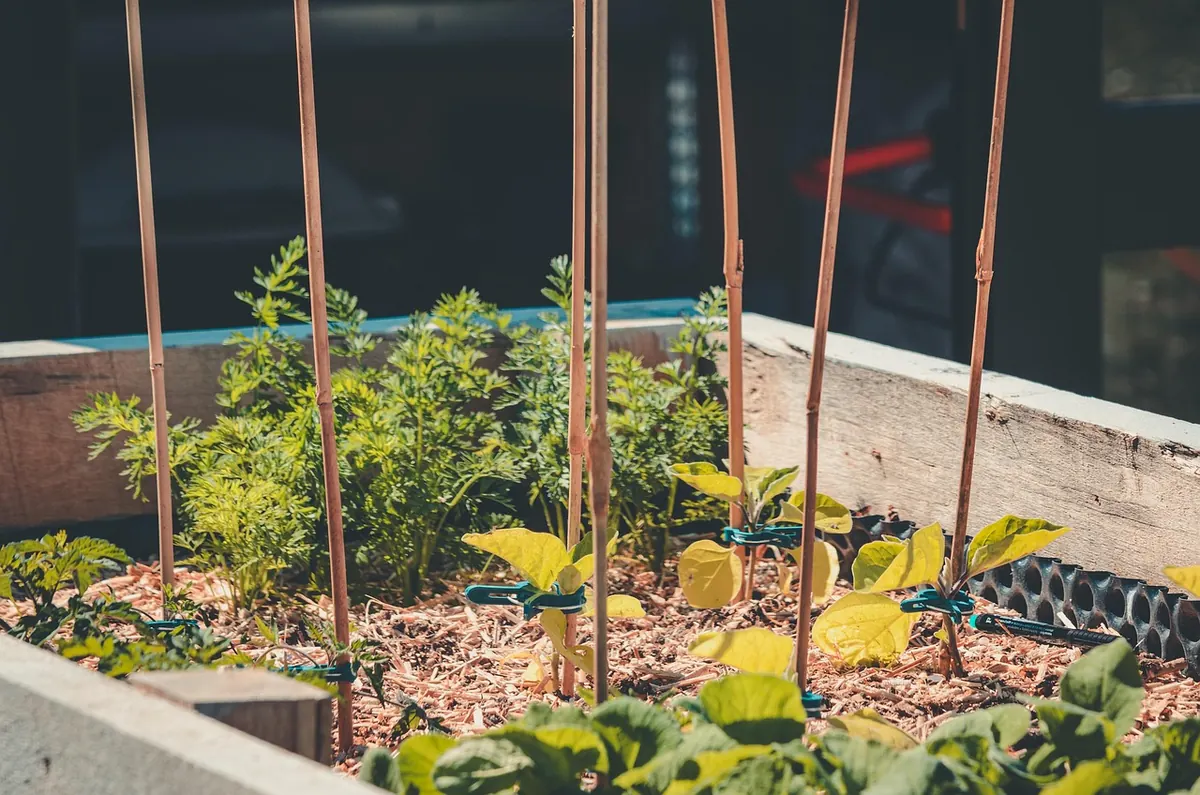
Group by water need, because vertical containers dry out faster than anything on the ground. Herbs near the kitchen door — thyme, sage, rosemary, and mint in its own pot so it does not take over — earn their place. Troughs of cut-and-come-again lettuce and strawberries work well at chest height. For trailing interest, nasturtium, ivy-leaf geraniums and sweet potato vine spill nicely over a railing. Climbers such as jasmine, clematis or morning glory need a trellis and a pot deep enough to be worth their while; a climbing rose wants something in the region of 40–45 cm deep.
Fix it without drilling
Tension poles, over-the-railing hooks, freestanding trellis panels wedged between wall and floor, and brackets screwed into a wooden fence post all avoid masonry work. If you are on a balcony, keep weight in mind: cluster a few generous planters rather than many heavy ones, use a lightweight potting mix, and check with your building management before adding anything substantial. Self-watering planters repay their cost in a hot week, and a simple drip line on a timer removes the daily can-carrier's job entirely.
Zone a Small Patio Without Building Walls
A small space needs two zones at most: somewhere to sit and eat, and somewhere to grow. Anything more becomes clutter. Change the floor to signal the shift — decking tiles, an outdoor rug, or a shallow tray of gravel under the planting end. A narrow planter 25–30 cm wide, or a slatted screen on one side only, will divide without boxing you in.
Place the seating near the door, where you actually use it, and put the growing end furthest away. Then open your door and look out: plants at the end of the view make the patio feel deeper than a wall of furniture. A diagonal arrangement of two chairs and a small table usually beats a rigid line along the fence.
Layer the Light the Way You Would Indoors
One bright light on the house wall flattens a patio and kills the mood. Work in three layers instead. Overhead, a festoon strung on a wire between house and boundary gives a soft ceiling. Mid-level, a wall lantern or a lantern on the table does the practical work. Low down, a couple of solar markers or candle lanterns pick out the planting.
Choose warm white bulbs, roughly 2700K, in fittings rated for outdoor use — IP44 at minimum for sheltered spots, higher for anything fully exposed. Skip the floodlight; pools of light are more forgiving and much kinder to neighbours. Battery and rechargeable options with a timer mean no wiring at all, which suits renters and anyone who would rather spend the weekend planting than chasing an electrician.
Soften the Edges With Fabric, Scent and Sound
Hard surfaces dominate small patios: paving, fence, wall, drainpipe. An outdoor rug is the single quickest way to make the floor feel like a floor rather than a yard, and cushions do the same for a bench. Keep them in a waterproof storage box so a shower does not end the season early.
Scent is underused. Put lavender, scented geranium or rosemary where you brush past it, and jasmine where you sit in the evening. Add one sound source — a small fountain, or a single chime, not three — and leave it at that. Small spaces punish collections; three good objects will always beat thirty.
Give the Ceiling and the Boundary Something to Do
Overhead is the forgotten surface. A shade sail, a wall-mounted umbrella, or a retractable awning makes the patio usable at midday and gives the space a sense of enclosure. On the boundary, a weatherproof mirror adds depth — just check what it reflects before you commit, because a mirror aimed at the bin store is worse than no mirror at all. Deep, muted colours on fences and walls recede; pale ones come forward, which is worth knowing if your boundary is closing in on you. A tall, narrow planter in front of a drainpipe hides it better than paint ever will.
Plan It on Paper, Then Build It Over a Weekend
Sequence the work and the project stays cheap and calm. Draw the plan with measurements, tape the furniture outlines on the paving, and buy plants last — once the bones are right, you will know what shape and height you actually need.
- Clear everything out and give the paving a proper scrub.
- Mark the zones and the walking line with tape.
- Lay the floor change, then fix the screen or divider.
- Assemble the furniture and test the walking line again.
- Mount the vertical planters and the trellis.
- Run the lights and check them after dark.
- Buy and place the plants, then add the rug, cushions and one scent source.
Then keep it simple. Ten minutes a week — a sweep, a check on watering, a wipe of the table, cushions back in the box — keeps the space ready to use rather than something you have to tidy before you can sit down. A garden room is not the one with the most in it. It is the one where the few things in it were chosen and placed deliberately.
Photo: Engin_Akyurt / Pixabay
Related Articles